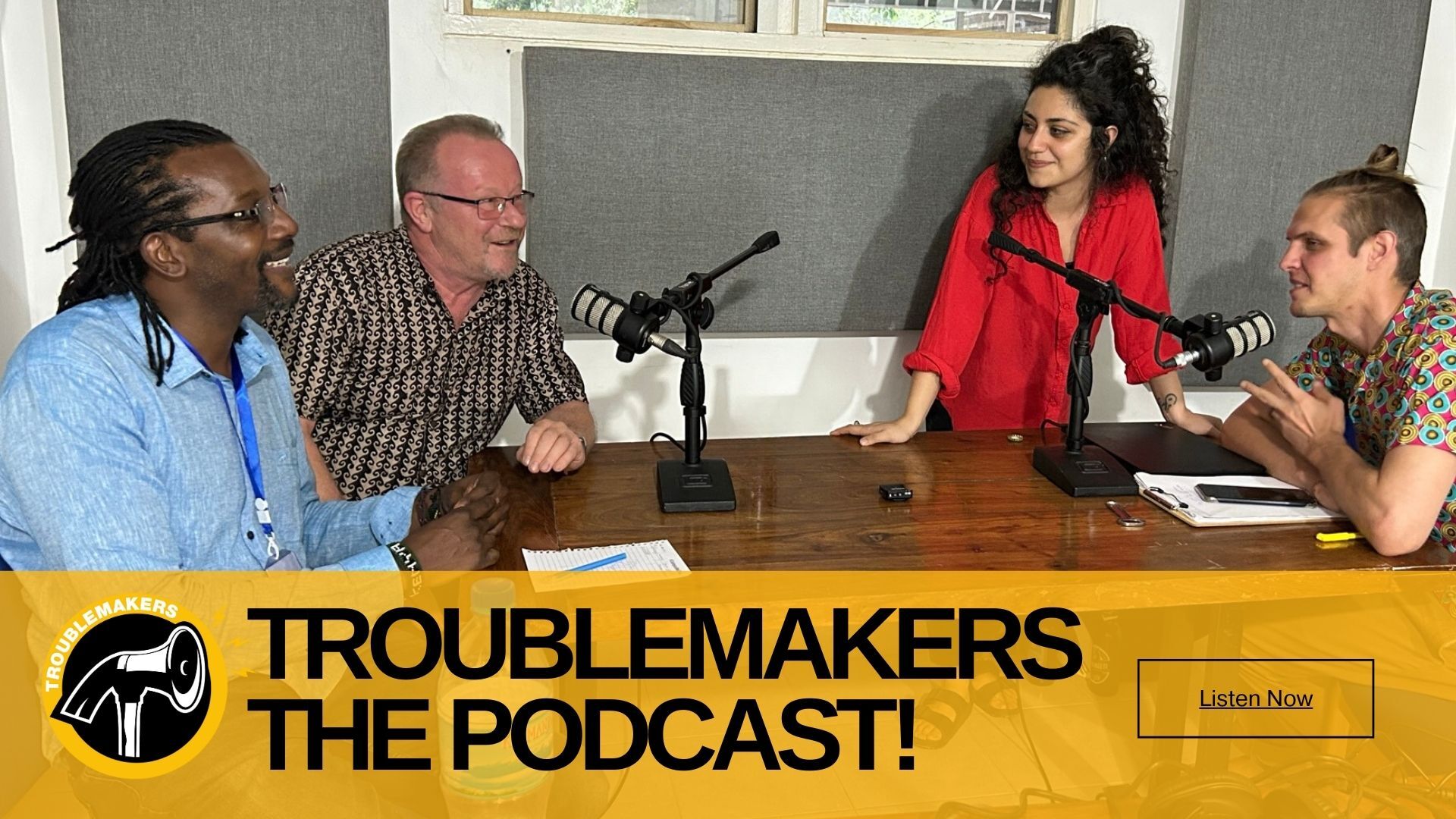





At TROUBLEMAKERS, we explore how to rebel in an age when a few elite have so much control. We speak with inspiring people from all walks of life across the planet on the tools they use to subvert and seize power for the transformation of our world. TROUBLEMAKERS is a place to learn from each other about how to make change. This podcast is a transcontinental operation brought to you by Beautiful Trouble, the Global Social Movement Centre, MS TCDC, and Global Platforms.
Episodes
7 days ago
7 days ago
42 min
What makes someone walk to the utility company with a placard instead of posting complaints online? Nalishebo Sinyama has been answering that since 2019, when a load shedding protest in her Lusaka suburb turned her into an organizer overnight. She sits with Given Kapolyo to trace her path from a grassroots ward organizer to national work, and now to feminist organizing in Somaliland. With Zambia's general election a week away, her message to young people is blunt: no one is coming to save you.
What you'll hear
The 2019 load shedding protest that started it all, and getting arrested before she even knew what organizing was
Finding Youth for Parliament as a safe space to be radical as a young woman
Feminism as a hard conversation, and the question from a young girl she still cannot answer
Being sexualized during the Patriotic Front adoption process, and naming it for what it is
In her words"The principle of organising does not change. What changes is the context.""Activism is a way of life. It is not a hobby. It is not a job.""Gender does not define how radical or how powerful someone should be.""No one is coming to help you. You have to stand up and speak out for yourself."
About the guestNalishebo Sinyama is a grassroots organizer from Zambia, now based in Somaliland, working to put young people and young women at the front line of change.
CreditsHosted by Given Kapolyo. A Troublemakers production, made at MS TCDC in partnership with Beautiful Trouble and MOVE.
Jul 24, 2026
Jul 24, 2026
2 min
TM Smoke Signals: Silence, by Sylvie Baziga
A spoken word piece by Sylvie Baziga on the slow deaths that leave no bullet holes: the swallowed cry, the smothered dream, the word never spoken because speaking means disappearing.
Here, pencils forget. But stones remember.
This poem is a warning and a promise. The silence is not empty. It is boiling. It is preparing. And when it finally breaks, it will not ask for permission.
Written and performed by Sylvie Baziga.A Troublemakers Smoke Signals production.
Jul 17, 2026
Jul 17, 2026
32 min
Host: Thompson Luzendi (Zambia)Guest: Joe Kobuthi - philosopher, public theologian, political analyst, and curator of The Elephant Pan-African magazine.
The rules of the house were written by someone who was never supposed to stay. Thompson sits down with Joe to unpack the moral political economy — what it is, how colonialism broke it, and what Gen Z across Africa needs to understand before 2027.
What We Cover
The moral political economy explained. Economics was never meant to be separated from ethics and politics. Neoliberalism broke that and turned it into a numbers game.
Colonialism as a restructuring of the house. It did not just steal land and labour. It rewrote the rules of African political, economic, and social life entirely.
Independence that changed nothing. For most African countries, colonial structures of governance remained intact and were turned against the same people they were built to oppress.
Three drivers shaping Gen Z today. Debt, technology, and multipolarity are reshaping how young Africans see themselves, the state, and the world.
2027 and beyond. A fragmenting Kenyan elite creates opportunity. But history shows conservative forces usually capture hard transitions. Gen Z must know exactly what country it wants to build.
Jul 10, 2026
Jul 10, 2026
11 min
Human rights defender, activist, and presidential candidate for the Republic of Kenya, Boniface Mwangi joins Smoke Signals for a direct, unfiltered conversation on what it will actually take for Kenya's Gen Z movement to convert street energy into political power by 2027.
This is not a motivational talk. It is a strategic briefing.
What We Cover
From occupation to ballot revolution. Boniface breaks down why "Ruto must go" is not enough. The movement needs political formations, a clear agenda, and serious civic education, not just for themselves but for the voters who still do not see young people as leaders.
Decentralisation without leaderlessness. A horizontal movement still needs a council of voices. Boniface argues that formal leadership is no longer optional if Gen Z wants to win.
Avoiding co-optation. You only get absorbed by the system if you have no agenda of your own. A movement with a clear vision is corruption-proof. Individual leaders may sell out. A movement with a mandate cannot.
The cost of challenging power. Surveillance, arrests, infiltration. Boniface gives practical advice on operational security: no routines, no technology in sensitive meetings, cell-based organising, and leaking misinformation to identify moles.
What governance must look like after 2027. Rule of law, social security, free education, free healthcare, land restitution, and full accountability for economic theft since independence.
The biggest mistake Gen Z could make. Joining or aligning with the current political class. Stay as far away as possible.
Closing message to those still in fear.When you lose your fear, they lose their power. Organise in spite of the threats. You are not only fighting for a better life. You are fighting for your right to exist.
Jul 3, 2026
Jul 3, 2026
4 min
A spoken word piece by Frank Amani on the cycles we inherit and refuse to break.
Same Stupidity confronts the ways human beings repeat patterns across generations, dressing up the same vicious circle in new clothes, chasing happiness while performing it, and calling it progress. The poem moves through denial, social conformity, collective forgetting, inequality, and the quiet violence of indifference. It ends where it begins: with the uncomfortable truth that we are not exempt. Not from stupidity. Not from death. Not from each other.
Because even the undertaker ends up in the jaws of death.Translation here: https://docs.google.com/document/d/1BqUOFQJR3ELEn3evRRaGLGer-y1xBCRd3GuchLdB9po/edit?usp=sharing
Listen now.
Jun 26, 2026
Jun 26, 2026
38 min
Guest: Wilson (Willynkya), film & TV producer, content creator, and influencer based in Tanzania
Rodgers sits down with Willynkya to unpack "Put Your Target in a Decision Dilemma" (Andrew Boyd & Joshua Kahn Russell) through the lens of content creation and film and what it means for activists and organisers trying to move audiences toward action.
About WillynkyaFive years in film and TV before transitioning fully into content creation. Known for travel and lifestyle content on Instagram and TikTok, and branded work at the intersection of storytelling and commerce.
What We Cover
The Empty Grave: Willynkya was the production manager on this Kijiweni Productions documentary about Tanzanian ancestral remains taken to Germany during the colonial era. It's screened at festivals across Tanzania and is currently streaming in Germany.
The Audience Dilemma in practice: How The Empty Grave was built to speak to four audiences at once: Tanzanian families, the German public, governments, and historians — each nudged toward their own decision.
Emotion in content: Hook with a problem, let your experience transfer to the viewer, make the first 5 seconds count, and design for both sound-on and sound-off viewing.
Industry challenges: Permits, financial literacy, the new Tanzania Film Board registration requirement, and the pressure to fake a lifestyle online.
For Organiser-TroublemakersWhen designing an action, ask: what are the two decisions my target can make, and how do both move my cause forward? Drop how you've used this in the comments.
Follow Willynkya: @willynkya on Instagram & TikTokThe Empty Grave: Follow Kijiweni Productions for screening updatesCredits:Production support: Thabit Kitamu
Jun 19, 2026
Jun 19, 2026
2 min
In this powerful spoken-word piece, poet Opolot Emmanuel Solomon paints a vision of an Africa that has moved beyond division, dependency, conflict, and limitation. Through repetition, imagination, and conviction, he challenges listeners to picture a continent where dreams become reality, borders no longer divide people, and Africans take ownership of their shared future.
Meet the Poet
Opolot Emmanuel Solomon is a Ugandan spoken word artist whose work explores hope, identity, social transformation, and the power of collective action. In Africa Will Be Saved, he invites us to imagine a future shaped not by outside forces, but by the choices Africans make today.
What We Unpack in This Piece
Imagining a Different AfricaA continent defined by opportunity, innovation, and shared prosperity.
Beyond BordersThe dream of a more connected Africa where people, ideas, and opportunities move freely.
Changing the StoryReplacing narratives of crisis and dependency with stories of achievement and self-determination.
Key Takeaway
Africa's future will not be written by fate alone. It will be shaped by the collective actions of Africans who dare to imagine a better continent, and work to make it real.
Anyone can use this podcast for free, with attribution to Troublemakers (the podcast). It is held under a Creative Commons Attribution 4.0 License and can be used for radio or any other media.
Our podcast is inspired by the Beautiful Trouble toolbox.
Resources & Show Links
Follow Troublemakers wherever you get your podcasts: https://linktr.ee/troublemakers.podcast
May 15, 2026
May 15, 2026
25 min
What does “development” really mean—and who is forced to pay for it?
Meet the Guest
Ziada is a climate and gender justice advocate working at the frontlines of renewable energy and community resistance. Trained in medicine, her activism was shaped by real encounters with inequality, environmental breakdown, and lives lost to preventable conditions.
What We Unpack in This Episode
What is EACOP, really?A massive oil pipeline from Uganda to Tanzania—sold as progress, contested on the ground.
The real cost of “development”Displacement. Lost livelihoods. Closed schools. Communities cut off from land and identity.
Why women are hit hardestEconomic exclusion, social disruption, and power imbalances intensified inside homes and communities.
Key Takeaway
“We don’t lack solutions—we lack implementation.”
Licensing
Anyone can use this podcast for free, with attribution to Troublemakers (the podcast). It is held under a Creative Commons Attribution 4.0 License and can be used for radio or any other media.
Acknowledgment
Our podcast is inspired by the Beautiful Trouble toolbox.
Resources & Show Links
Green Conservers – connect via social media to support or collaborate
May 8, 2026
May 8, 2026
6 min
What happens when poetry becomes testimony?What happens when a voice carries the grief, rage, memory, and survival of an entire people?
In this deeply emotional and politically charged episode of Troublemakers, we journey through “Vous allez où?”, a haunting spoken-word piece that confronts war, displacement, colonial violence, exile, and the persistence of hope in places the world often chooses to ignore.
Through vivid imagery and painful truths, the poem paints a world where mothers bury children, rivers carry bodies instead of songs, and children draw rifles instead of suns. Yet even within devastation, there remains resistance the stubborn insistence on dignity, memory, and life itself.
This episode reflects on:
War as a lived daily reality, not a distant headline
Forced displacement and the psychology of exile
The silencing of oppressed voices
Colonial legacies and systems of domination
At its core, this episode asks:Where do people go when home itself becomes unlivable?And what does it mean to continue dreaming in a world built to erase you?
This is not just poetry. It is testimony. It is mourning. It is resistance.
Anyone can use this podcast for free, with attribution to Troublemakers (the podcast). It is held under a Creative Commons Attribution 4.0 License and can be used for radio or any other media.
Apr 28, 2026
Apr 28, 2026
1hr 3 min
How do we move from gathering stories to creating impact? How can we be more strategic about story gathering? And who truly owns the narrative - organisations or the communities themselves?
In this episode of Troublemakers, we explore the role of storytelling in activism and development, featuring insights from practitioners working across Brazil and Nepal within ActionAid. This conversation unpacks how stories are gathered, shaped, and used. It explores the role of ActionAid in story gathering and reflects on why rethinking storytelling is essential for justice-driven work.
Guest Host
● Joan Njoroge – Moderator of this conversation, guiding a deep dive into how storytelling shapes advocacy, impact, and community voice within global movements.
Guest Speakers
● Erika Azevedo – Coordinator of Public Engagement at ActionAid Brazil, with a background in journalism and documentary storytelling.
● Anish Shrestha– Communications Manager at ActionAid Nepal, working closely with grassroots communities to amplify lived experiences.
Reflections
This episode highlights a key shift: storytelling must be decolonial, feminist, and human-centred. It’s not just about telling better stories — it’s about better planning and collaboration to avoid overload, more focus on agents of change, and amplifying people’s voices to different audiences.
License
Anyone can use this podcast for free, with attribution to Troublemakers (the podcast). It is held under a Creative Commons Attribution 4.0 License and can be used for radio or any other media.
Resources & Show Links
● Subscribe: https://linktr.ee/troublemakers.podcast
● ActionAid Global: https://www.actionaid.org
● Beautiful Trouble Toolbox: https://beautifultrouble.org/toolbox/