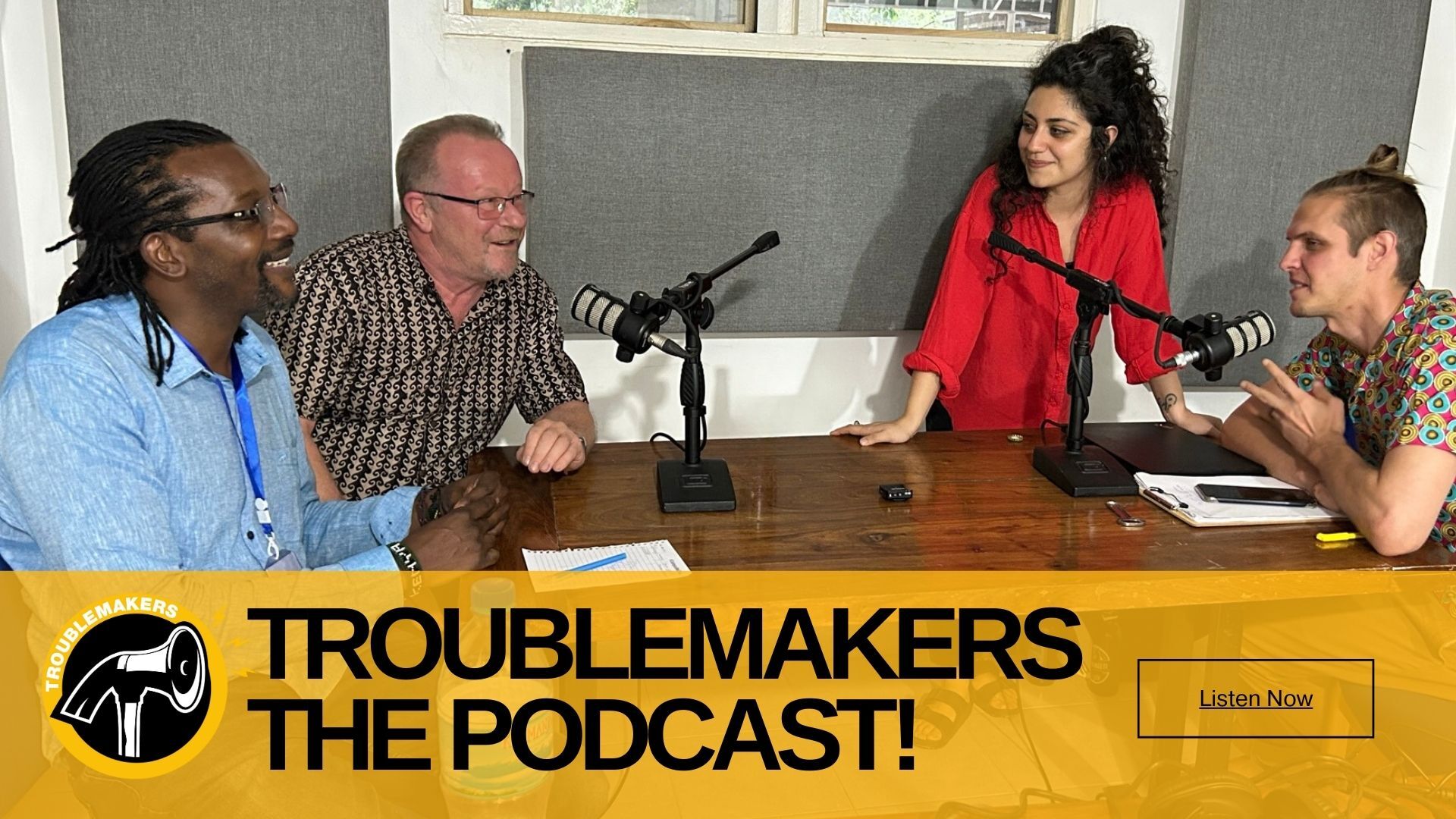





At TROUBLEMAKERS, we explore how to rebel in an age when a few elite have so much control. We speak with inspiring people from all walks of life across the planet on the tools they use to subvert and seize power for the transformation of our world. TROUBLEMAKERS is a place to learn from each other about how to make change. This podcast is a transcontinental operation brought to you by Beautiful Trouble, the Global Social Movement Centre, MS TCDC, and Global Platforms.
TROUBLEMAKERS
At TROUBLEMAKERS, we explore how to rebel in an age when a few elite have so much control. We speak with inspiring people from all walks of life across the planet on the tools they use to subvert and seize power for the transformation of our world. TROUBLEMAKERS is a place to learn from each other about how to make change. This podcast is a transcontinental operation brought to you by Beautiful Trouble, MOVE the Global Social Movement Centre, MS TCDC, and Global Platforms.
Listen on:
Episodes

4 days ago
4 days ago
How does misinformation spread in conflict zones, and what are the consequences for communities and human rights defenders?
In this episode, journalist Josué Mutanava speaks with Espoir Hamoni, a human rights defender based in Uvira, South Kivu, in the eastern Democratic Republic of Congo. They discuss how disinformation, rumors, and fake news in eastern DRC can fuel hate speech, community tensions, displacement, and insecurity, while making it harder for human rights defenders to document abuses. Originally recorded in French by Soma Media Lab in Goma, this episode highlights the importance of media literacy, reliable journalism, and community awareness in countering misinformation. The English transcript is available in the episode description, and the video can be watched on YouTube with English subtitles.English Transcript: https://bit.ly/4uirWle
YouTube Channel: https://bit.ly/4b8bxGW
.................
Comment la désinformation dans les zones de conflit affecte-t-elle les communautés et les défenseurs des droits humains ?
Dans cet épisode, le journaliste Josué Mutanava s’entretient avec Espoir Hamoni, défenseur des droits humains basé à Uvira, au Sud-Kivu, dans l’est de la RDC. Ils discutent de l’impact des rumeurs, fake news et manipulations de l’information sur les tensions communautaires, les déplacements de population et la sécurité, ainsi que sur le travail des défenseurs des droits humains. L’épisode a été enregistré en français par Soma Media Lab à Goma. La transcription en anglais est disponible dans la description de l’épisode, et la vidéo peut être regardée sur YouTube avec des sous-titres anglais.YouTube: https://bit.ly/4b8bxGW

Friday Feb 20, 2026
Friday Feb 20, 2026
What makes a workplace meaningful? Is it the salary? The office setup? The title on the door? Or is it something quieter? Something human?
In this episode of Troublemakers: Smoke Signals, we step into the everyday spaces where we spend so much of our lives. From the vibrant grounds of MS TCDC, home to the Samora Machel Studio where The Troublemakers is produced, to offices, clinics and creative corners beyond Arusha.
We asked a simple question:
What do you love most about your workplace?
The answers surprised us in their consistency.
Broader Reflections
At a time when burnout is normalised and productivity is worshipped, reclaiming joy and solidarity in our workplaces becomes radical.
The workplace is not separate from the struggle for dignity, justice, and collective wellbeing. It is one of the spaces where we practice it.
Licensing
Anyone can use this podcast for free, with attribution to Trouble Makers (the podcast). It is held under a Creative Commons Attribution 4.0 License and can be used for radio or any other media. Our podcast is inspired by the Beautiful Trouble toolbox.
Resources & Show Links
Troublemakers Linktree: https://linktr.ee/troublemakers.podcast

Friday Feb 13, 2026
Friday Feb 13, 2026
How do movements shift people from neutrality or even opposition into active allies for justice struggles?
In this episode of the Troublemakers podcast, Monica hosts Sungu Oyoo, a writer, educator, activist, and Pan-Africanist. Sungu works with MWAMKO (Pan-African Popular Pedagogy Collective) as Director of Special Programs and Organisational Development and is also part of Kongamano Lamapinduzi, where he serves as National Spokesperson.
Key Discussion Points & Insights
Society Is Not a Monolith
Drawing from Beautiful Trouble, particularly work by Joshua Kahn Russell, Sungu explains that effective organising requires mapping society into segments, allies, neutral groups, and opponents rather than speaking to a vague “public.”
Lessons from Kenya’s Cost of Living and Finance Bill Protests
Sungu traces organising evolution from earlier cost-of-living struggles to the 2024 mass protests, showing how:
Early movements often “preached to the choir”
Social media + grassroots organising created rapid mobilisation
Strategic escalation shifted demands from policy rejection → systemic accountability
Strategic Escalation & The Domino Effect
A core organising insight:
Shift easier blocks first (neutrals → passive allies → active allies) rather than focusing energy on entrenched opponents.
Once one segment shifts, others often follow.
Licensing
Anyone can use this podcast for free, with attribution to Trouble Makers (the podcast).
It is held under a Creative Commons Attribution 4.0 License and can be used for radio or any other media. Our podcast is inspired by the Beautiful Trouble toolbox.
Resources & Show Links
Follow Sungu via social media (Sungu Oyoo)
Contact Mwamko Africa for book access and organising resources
Credits;
Host Monica Kamandau
Guest: Sungu Oyoo
Editor & Producer: Rodgers George
Music: Mwaduga Salum & Beautiful Trouble

Friday Jan 30, 2026
Friday Jan 30, 2026
What does it really mean to “build the nation,” and who pays the price for that work?
In this Smoke Signals episode, Monica Kamandau reads Building the Nation by Ugandan poet Henry Barlow, a biting and darkly humorous poem that exposes the everyday hypocrisies of power, privilege, and sacrifice in postcolonial African states.
This reading lands powerfully in our current moment, where ordinary people are repeatedly told to endure hardship in the name of progress, stability, or patriotism.
Key Ideas and Highlights
Nation-building as performance, where power is exercised through routine and ceremony rather than service
The quiet violence of inequality hidden behind jokes, lunches, and official duties
Satire as resistance, and poetry as a mirror held up to political hypocrisy
Why This Poem Still Matters
Henry Barlow’s Building the Nation remains painfully relevant across Africa and beyond. It challenges listeners to question who benefits from the language of sacrifice, and whose hunger is normalised in the process.
Monica Kamandau’s reading brings fresh urgency to the poem, inviting us to reflect on leadership, accountability, and the everyday cost of governance.
Credits
Poem: Building the Nation by Henry Barlow (Uganda).
Reader: Monica Kamandau.
Producer: Rodgers George.
Licensing
Anyone can use this podcast for free, with attribution to Troublemakers (the podcast). It is held under a Creative Commons Attribution 4.0 License and can be used for radio or any other media. The Beautiful Trouble toolbox inspires our podcast.

Friday Jan 23, 2026
Friday Jan 23, 2026
What does it mean to fail forward in organising, and how do movements survive across generations?
In this episode, recorded at Mashujaa Heritage Archives in Kibichuku, Monica Kamandau sits down with veteran Kenyan organiser and scholar Njuki Githethwa. With nearly three decades in resistance and movement building, Dr. Njuki reflects on the evolution of Kenya’s struggles, from the Mau Mau movement to today’s Gen Z protests and the Kenya Left Alliance.
Key Ideas and Highlights
Failing forward as a movement practice
Movements must evolve, regroup, and shed their skin in order to survive. Failure is not an end point, but a foundation for renewal.
Mobilising versus organising
Life and death issues bring people to the streets, but ideology, identity, and belonging are what sustain movements over time.
Liberated zones as paths to revolution
Small, tangible victories and spaces of freedom inspire people and show what justice and liberation can look like in practice.
Licensing
Anyone can use this podcast for free, with attribution to Trouble Makers (the podcast). It is held under a Creative Commons Attribution 4.0 License and can be used for radio or any other media. The Beautiful Trouble toolbox inspires our podcast.
Resources & Show Links
Mashujaa Heritage Archives, Kibichuku
Fail Forward
Credits
Host: Monica Kamandau
Guest: Njuki Githethwa
Producer & Audio Producer: Rodgers George
Music: Beautiful Trouble & Mwaduga Salum

Wednesday Dec 10, 2025
Wednesday Dec 10, 2025
Ep42: Civil Disobedience with Faith Kasina
When does breaking the law become the only way to survive?
In this episode, we sit down at the Kayole Social Justice Centre with organizer Faith Kasina and members of the Centre to explore civil disobedience in moments when the state fails its people. Faith walks us through protest organizing during COVID, the realities of living under Article 43 violations, and how communities confront gunism, police violence, and the politics of being branded as criminals while demanding dignity. This is a direct, honest conversation from those living the struggle daily.
Key Ideas and Highlights
Civil disobedience emerges when government directives clash with lived reality, especially in informal settlements lacking food, water, housing, and healthcare.
Gunism is rooted in economic deprivation and political manipulation; organizers share how political education and exposure are used to reclaim young people from being weaponized.
Peaceful protesters are often branded as violent, yet protest remains a constitutional right. The community shares strategies for navigating this risk while staying grounded in justice.
Licensing
Anyone can use this podcast for free, with attribution to troublemakers (the podcast). It is held under a Creative Commons Attribution 4.0 License and can be used for radio or any other media. Our work is inspired by the Beautiful Trouble toolbox.
Resources and Show Links
Kayole Community Justice Center
Article 43 of the Kenyan Constitution
Civil Disobedience Beautiful Trouble toolbox
Credits
Host: Monica Kamandau
Guest: Faith Kasina and Kayole Social Justice Centre members
Producer: Rodgers George
Music: Beautiful Trouble and Mwaduga Salum

Wednesday Dec 03, 2025
Wednesday Dec 03, 2025
What is the true story behind America’s gun culture beyond Hollywood’s dramatised scenes?In this Smoke Signal, we unpack the myths, realities, and politics behind gun violence in the United States through lived experience, global perception, and the unchecked power of the gun industry.
Growing up outside the U.S., many of us see America through movies: chaotic streets, armed civilians, danger at every corner. But how much of that imagery mirrors real life? In this conversation, we explore how easy access to guns, racialised oppression, economic precarity, and political mythology fuel a crisis that has become tragically normalised. From childhood gun training to mass shootings, from Walmart gun aisles to parents organizing for their children’s safety, this is a raw look at a nation shaped by firearms.
Key Ideas and Highlights
Hollywood vs. Reality: Movies exaggerate, but the core problem is real — guns are incredibly easy to access in the U.S., shaping both culture and violence.
Race, Power, and Mythology: America’s obsession with guns is tied to white settler identity, political polarisation, and billion-dollar lobby groups like the NRA.
Everyday Consequences: From children pretending to be armed for safety to families losing loved ones over a bag of food, gun violence reflects deeper economic and political failures.
Licensing
Anyone can use this podcast for free with attribution to Troublemakers (the podcast). It is under a Creative Commons Attribution 4.0 License and may be used for radio or any other media. Our podcast is inspired by the Beautiful Trouble toolbox.
Resources & Show Links
Home | Moms Demand Action
Research on the U.S. gun lobby and NRA influence (https://bit.ly/4asCSFc)
Articles on Walmart’s role in firearm sales (https://bit.ly/445b71C)
Credits
Hosts: Phil Wilmot & Rodgers George
Music: Beautiful Trouble & Mwaduga Salum

Tuesday Nov 25, 2025
Tuesday Nov 25, 2025
What happens when a movement falls in love with one tactic?In this episode, we visit Githurai Social Justice Centre to explore how Kenyan organisers can move beyond protest fatigue and rethink the power of people-centred strategies.
Njoki Gachanja is a community organizer, political and social justice activist, and community lawyer. She coordinates the Githurai Social Justice Centre, where she works with youth, artists, and local networks to build people power from the ground up. Njoki walks us through why mandamano became so central, what its limits are, and what it will take to build fresh, effective, and unified tactics for today’s Kenya.
Key Ideas and Highlights
Anger fuels action, but anger is not a strategy. Effective organizing requires clarity, love, unity and the courage to imagine alternatives, not only resistance.
Kenya’s most powerful organizing spaces are not always the streets. Churches, football pitches, TikTok, markets, and clubs already gather thousands and can be transformed into political education spaces.
We win when our currency is truth. In the digital age, political clarity, fact checking, and fidelity to the people are essential for resisting misinformation and building sustainable movements.
Licensing
Anyone can use this podcast for free, with attribution to Trouble Makers (the podcast). It is held under a Creative Commons Attribution 4.0 License and can be used for radio or any other media. Our podcast is inspired by the Beautiful Trouble toolbox.
Resources and Show Links
Githurai Social Justice Center (Facebook, X)
Beautiful Trouble toolbox
Credits
Host:Monica KamandauGuest: Njoki GachanjaProduction: Rodgers GeorgeMusic: Beautiful Trouble and Mwaduga Salum

Tuesday Nov 11, 2025
Tuesday Nov 11, 2025
How do millennials and Gen Z work together in social movements when their values, experiences, and approaches often clash? In this episode of Troublemakers (TM) Smoke Signals, we explore intergenerational dynamics in activism, examining the tensions and opportunities that arise when younger and older generations collaborate or collide.
Key Ideas and Highlights:
Different Values, Shared Goals: Millennials often emphasise respect for hierarchy and experience, while Gen Z demands accountability and direct action. Understanding these differences is key to effective collaboration.
Mutual Learning Across Ages: True solidarity happens when generations engage in genuine relationships, mentoring, and shared learning. Eldership is earned through curiosity, presence, and openness, not simply age.
Shared Struggle Against Systems: Economic pressures, systemic inequities, and structural power imbalances affect both generations. Recognising common challenges fosters solidarity beyond generational divides.
Licensing: Anyone can use this episode for free, with attribution to Troublemakers (the podcast). We operate under a Creative Commons Attribution 4.0 License and draw inspiration from the Beautiful Trouble toolbox.
Credits:
Hosted by Phil and Rodgers George | Produced by Rodgers George | Music by Beautiful Trouble & Mwaduga Salum | Edited by Monica Kamandau

Tuesday Nov 04, 2025
Tuesday Nov 04, 2025
Why Are We Obsessed with Being the Hero?
In this episode, Dr Mette Fog Olwig, a geographer, author, and storyteller, examines how “hero narratives” shape global climate, sustainability and development responses. Her new book, A Bit Too Simple: Narratives of Development, Sustainability and Climate Change (Cambridge University Press, 2025, open access), looks at the origin and current iteration of these hero narratives, starting with the problematic narrative of the “white man’s burden”, and exposes how they sideline the real voices living through the crisis.
Key Ideas and Highlights
The Hero Narrative in Climate ActionMette reveals how some “sustainability” efforts, such as many carbon offset initiatives, turn practitioners, companies and consumers into heroes of global rescue stories—overshadowing the real, complex struggles of affected communities.
The Power and Peril of Meta-NarrativesBig stories about progress and heroism can inspire action, but they can also erase nuance and silence local voices.
Storytelling as Organizing
Inspired by the Beautiful Trouble toolbox, Mette shows how storytelling isn’t just communication; it’s collective organizing that builds power and shared purpose.
Licensing
Anyone can use this podcast for free, with attribution to Troublemakers (the podcast). It is held under a Creative Commons Attribution 4.0 License and can be used for radio or any other media. Our podcast is inspired by the Beautiful Trouble toolbox.
Resources & Show Links
A Bit Too Simple: Narratives of Development, Sustainability and Climate Change by Mette Fog Olwig – Cambridge University Press, 2025 (open access)
Explore the Beautiful Trouble Toolbox: https://beautifultrouble.org Credits
Host: Phil Wilmot | Guest: Mette Olwig | Producer: Rodgers George | Editor: Monica Kamandau.